Showing posts with label pop music. Show all posts

1975: The Glitter Band: Goodbye My Love

1975 / Goodbye My Love / Glitter Band
1975: The Glitter Band release Goodbye My Love

  • Published in 1974, Goodbye My Love was The Glitter Band's fourth consecutive (and their biggest) UK Top 10 hit as an independent act - separate from the now-disgraced Gary Glitter.
  • The track peaked at Number 2 in the British charts for a solitary week in early February 1975.
  • The single which prevented it from hitting the top spot was January by Pilot.
  • The song was written by band member, the late Gerry Shephard, who wrote or co-wrote most of the act's hits.
  • The single is included on the band's 1975 Top 20 album Rock 'n' Roll Dudes.
  • Following Goodbye My Love, The Glitter Band would enjoy three further UK Top 20 hits before glam rock would succumb to the onslaught of punk rock.


1974: Leo Sayer: The Show Must Go On

Leo Sayer / The Show Must Go On
1973/1974: Leo Sayer performs The Show Must Go On

  • After the failure of his debut single, Why is Everybody Going Home?, The Show Must Go On became Leo Sayer's first UK hit record.
  • The song began its chart career at the end of 1973, but peaked at Number 2 for one week in mid to late January 1974.
  • The single that kept it from the top of the charts was You Won't Find Another Fool Like Me by The New Seekers.
  • At the time, Sayer would perform the song dressed and made up as a Pierrot clown.
  • The single is a track from Sayer's first album Silverbird, which also peaked at Number 2 (behind The Carpenters' compilation album, The Singles 1969-1973).
  • The Show Must Go On began a run of seven consecutive Top 10 hits for Sayer in the UK, including a Number 1 (1977's When I Need You) and two further Number 2 songs. 
  • Although this original version failed to dent the charts in America, a cover by Three Dog Night made the Top 10 (#4) on the Billboard Hot 100 later in 1974, becoming the band's last single to do so.
  • In Leo Sayer's version, the final line of the chorus is "I won't let the show go on". Three Dog Night changed the lyric to "I must let the show go on", which Sayer was apparently unhappy about.

Image by AVRO (Beeld En Geluid Wiki - Gallerie: Toppop 1974) [CC BY-SA 3.0 ], via Wikimedia Commons


1973: T. Rex: Solid Gold Easy Action

1972/1973: T.Rex: Solid Gold Easy Action

  • Solid Gold Easy Action was T.Rex's eighth consecutive UK Top 2 single since the release of Ride A White Swan in 1970.
  • Released in 1972, the record peaked at Number 2 for one week on the British charts in early January 1973, blocked from the Number 1 spot by Little Jimmy Osmond's Long Haired Lover From Liverpool.
  • Unlike some earlier T.Rex singles, the track made no impression on the American charts.
  • It sold well enough in Ireland, Norway and Germany to feature in each of those country's Top 10s.
  • It was never featured on any of the band's albums at the time, but did appear on the 1972 Great Hits compilation issued by EMI.
  • Some have suggested that this song was Bolan's prediction of his death five years later, as it features the opening line "Life is the same and it always will be / Easy as picking foxes from a tree." The registration number on the vehicle in which Bolan was killed on 16 September 1977 was FOX 661L. And, the car struck a tree.


1972: Don McLean: American Pie

American Pie / Don McLean
Don McLean: American Pie

  • American Pie was Don McLean's first significant chart entry on both sides of the Atlantic, lifted from the album of the same name.
  • The track peaked at Number 2 in the UK for three weeks in February/March 1972, held off the top of the charts by both Chicory Tip's Son of My Father and Nilsson's Without You.
  • In the States, the single topped the Billboard Hot 100 for four weeks in early 1972, repeating the feat in Australia, Canada and New Zealand.
  • The single (Parts I & II) remains the longest - at 8:37 - to hit Number 1 in America.
  • American Pie has returned to the British charts on two further occasions to date: 1991 (No.12) and 2012 (No.78).
  • Madonna recorded a shortened dance version for her album The Next Best Thing (Soundtrack, 1991) and released it as a single which climbed to Number 1 in the UK and other European territories. Although not released in the US, it managed a chart placing (No.29) on airplay alone.
  • The song is now considered a classic of American pop culture detailing "the loss of innocence of the early rock and roll generation as symbolized by the plane crash which claimed the lives of three of its heroes" - Buddy Holly, The Big Bopper, and Ritchie Valens. (Reference)
  • In April 2015, the 16-page original manuscript for the song, along with detailed notes, drafts and alternate verses, was sold at Christie’s in New York for $1.2 million.
  • In 2017, McLean's original recording was selected for preservation in the National Recording Registry by the Library of Congress as being "culturally, historically, or artistically significant". (Reference)


1971: The Mixtures: The Pushbike Song

The Mixtures / The Pushbike Song
1971: The Mixtures: The Pushbike Song

  • The Pushbike Song was the follow-up to The Mixtures' cover of Mungo Jerry's In the Summertime - both Number 1 hits in their homeland of Australia.
  • It peaked at Number 2 in the UK in early February 1971 and remained there for four consecutive weeks.
  • It was held off Number 1 by the George Harrison classic, My Sweet Lord.
  • It remained on the UK Singles Chart for 21 weeks, selling sufficient copies to make it the sixth best selling single of the year.
  • It remains the group's only chart hit in the UK, although they had moderate success in Australia with two follow-up songs: Henry Ford and Captain Zero.
  • It didn't quite make the Top 40 in America, peaking at #44 on the Billboard Hot 100.
  • The group's bass player died in a fishing accident in 1978 and the band split not long after. Adding two more more members, the group eventually continued under a different guise, BRIX.


1970: Elvis Presley: Suspicious Minds

Elvis Presley / Suspicious Minds record cover
Elvis Presley

  • Elvis's version of Suspicious Minds peaked at Number 2 in the UK in January 1970, making it the first single of the Seventies to do so.
  • It was held off the Number 1 position for one week by Two Little Boys from Rolf Harris.
  • It peaked at Number 1 in the US in November 1969, Presley's first American chart-topper in seven years.
  • Suspicious Minds was Elvis's final US Number 1, although he would return to the top of the UK charts in 1970 with The Wonder of You. He had several posthumous Number 1 hits in the UK, including Way Down which climbed to the top just after his death in 1977.
  • The recording features the famous false ending - the producer adding an early fade before a booming Presley returns with his ongoing repetition of the chorus.
  • The song prompted a dispute about money between Elvis and his manager Colonel Parker when the copyright owner turned down demands to surrender a percentage of the publishing royalties. Presley won out in the end.
  • The single has appeared on the UK chart on three separate occasions: its original 1969 release, a 2001 re-release (#15 peak) and a 2007 release to commemorate the 30th anniversary of Presley's death (#11 peak).
  • Download Suspicious Minds here.


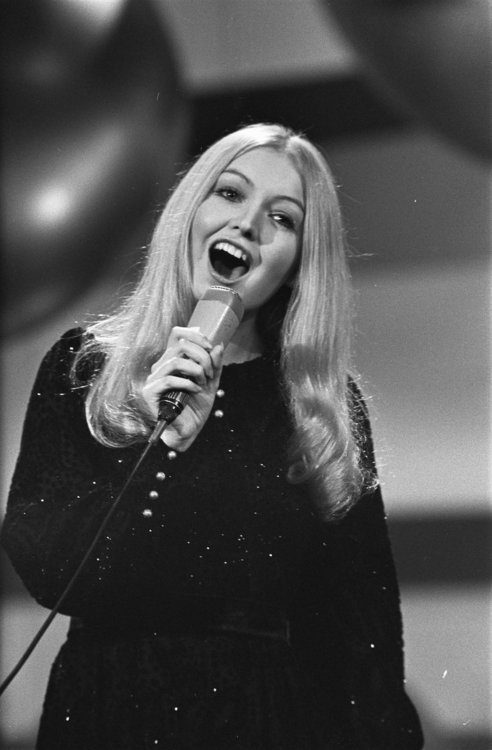
1970: Mary Hopkin: Knock, Knock Who's There?

Mary Hopkin / 1970 Eurovision Song Contest
Mary Hopkin
  • This song was Mary Hopkin’s final UK Top 10 hit in March/April 1970.
  • It was prevented from reaching Number 1 by Simon & Garfunkel’s Bridge Over Troubled Water.
  • The track was Hopkin’s second UK Number 2 hit following 1969’s Goodbye.
  • Knock, Knock Who’s There? was the UK’s entry at the 1970 Eurovision Song Contest.
  • The song finished second with 26 points behind Ireland’s All Kinds of Everything.
  • The single’s B-Side was I’m Going to Fall in Love Again, the runner-up from the UK’s 1970 Song For Europe competition to decide its Eurovision entry.
  • Mary Hopkin reportedly dislikes both songs intensely.
  • In Australia, a cover version by Liv Maessen peaked at Number 2 on that country’s national chart.

[Above image by Nationaal Archief, Den Haag, Rijksfotoarchief: Fotocollectie Algemeen Nederlands Fotopersbureau (ANEFO), 1945-1989 - negatiefstroken zwart/wit, nummer toegang 2.24.01.05, bestanddeelnummer 923-3712 (Nationaal Archief) [CC BY-SA 3.0 nl], via Wikimedia Commons]


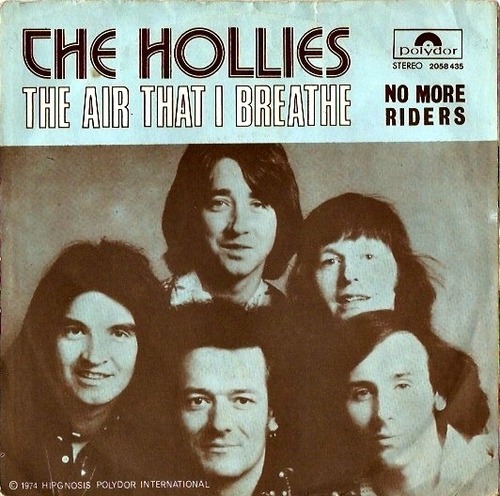
1974: The Hollies: The Air That I Breathe

The Air That I Breathe The Hollies record cover
The Hollies

  • Disregarding re-releases The Air That I Breathe was The Hollies’ final UK Top 10 hit. 
  • The song reached Number 2 in March 1974.
  • It was kept from Number 1 by Paper Lace’s Billy, Don’t Be A Hero.
  • It became a Top 10 hit across Europe, as well as peaking at Number 6 in the US and Number 5 in Canada.
  • The song was written by Albert Hammond and Mike Hazlewood.
  • It’s included on Hammond’s 1972 album, It Never Rains in Southern California.
  • The writers won a lawsuit for plagiarism against English rock band Radiohead for similarities of the track Creep to The Air That I Breathe.
  • Simply Red covered the song and took it into the UK Top 10 in August 1998.
  • The Hollies’ version was re-released in the UK in 1988, peaking at Number 60.


1973: The Strawbs: Part of the Union

Part of the Union / The Strawbs
The German Record Sleeve

  • It was February 1973 and the UK was in the middle of a political conflict between the unions and the government of the day.
  • As a consequence, it seemed as if the whole country was on strike. Power cuts were common, as was what became known as the Three Day Week. It wasn’t all bad, though. There were still some great tunes about and one of them came from folk-rock exponents, The Strawbs.
  • Written by group members John Ford and Richard Hudson, Part of the Union was the band’s tongue-in-cheek tribute to the working man. Highly commercial, it is a sing-a-long number which struck a chord with record buyers, who sent it up to Number 2 in the UK charts.
  • This was The Strawbs’ biggest UK hit, though. While they were hugely popular on the live circuit, they could only manage two other hit songs: Lay Down and Shine On Silver Sun.
  • Part of the Union was kept off the top spot by Blockbuster! by The Sweet and Cum On Feel the Noize by Slade.